Category Archives: El Salvador
El Salvador 2014
The second round of presidential elections were held in El Salvador on March 10, 2014. The President, who is head of state and government, is elected to a four-year term with no possibility for consecutive reelection.
The first round was held on February 2, which I covered in a thorough post which also looked at Salvadoran history. In the first round, Salvador Sánchez Céren, the candidate of the governing left-wing Farabundo Martí National Liberation Front (Frente Farabundo Martí para la Liberación Nacional, FMLN), took a very wide lead in the first round – 48.9% – nearly enough to win by the first round. Sánchez Céren, a Vice President and former education minister in President Mauricio Funes’ outgoing government, is a former guerrilla leader during El Salvador’s 13-year long civil war (1979-1982) and is traditionally identified as a member of the FMLN’s traditional dogmatic hardline left-wing; in contrast to Funes, an independent journalist prior to his election in 2009 and very much a moderate, pragmatic social democrat during his term. His second round opponent was Norman Quijano, the conservative mayor of San Salvador who stood for the Nationalist Republican Alliance (Alianza Republicana Nacionalista, ARENA), the anti-communist, pro-American and conservative party which ruled El Salvador between 1989 and 2009. Quijano placed a distant second with 39% of the vote.
The FMLN’s first round success owes to the party’s strong campaign, its fairly popular record in government since 2009 and the weakness of ARENA’s campaign. Although Sánchez Céren is from the FMLN’s left-wing, he did not suffer a fate similar to the FMLN’s 2004 presidential candidate, former communist leader Schafik Handal. Instead, Sánchez Céren ran a moderate campaign which focused on the FMLN’s record and promised social investments, poverty reduction rather than dogmatic chavismo and anti-Americanism. Sánchez Céren compensated his own left-wing roots by choosing a popular moderate running mate, Óscar Órtiz, the popular four-term mayor of the conservative city of Santa Tecla. The FMLN’s campaign was smooth, calm, consensual and disciplined. It also received thinly veiled support from the incumbent President, Mauricio Funes, who devoted most of his time during the campaign to attack ARENA and lead the charge in publicizing corruption cases against ARENA; many noted that Funes was doing the FMLN’s ‘dirty work’, allowing the FMLN’s actual candidate to be more consensual.
In contrast, ARENA’s first round campaign was widely described as disastrous. Since losing power in 2009, the former governing party suffered a major split, when former President Antonio Saca (2004-2009) was expelled from ARENA and founded his own party, the Grand Alliance for National Unity (Gran Alianza por la Unidad Nacional, GANA), alongside 12 lawmakers. ARENA did, nevertheless, win the 2012 legislative elections; although subsequent defections have since cost it its plurality in the unicameral legislature. Saca, in coalition with two old centre-right parties, won 11.4% in the first round. The former President remains widely perceived as a ‘traitor’ by many in ARENA ranks and there was public divisions in ARENA between the two rounds on whether or not Quijano should approach Saca to form an alliance. Ultimately Saca did not endorse anybody.
What really sunk ARENA, however, was a major corruption case involving former President Francisco Flores (1999-2004) – who, to make matters worse, was Quijano’s campaign manager. Revealed by Funes and GANA, Flores is alleged to have embezzled $10 million in earthquake relief funds from Taiwan in 2001. Flores was forced to appear in front of a legislative committee in January, and stunningly revealed that it was ‘maybe’ $15-20 million which he had bagged from Taiwan. Flores attempted to leave the country illegally in late January; an arrest warrant was later issued, but Flores is now MIA. For unclear reasons, Quijano stuck by Flores until two days before the election.
Despite the FMLN’s efforts, since 2009, to present itself as a moderate social democratic party, it hasn’t convinced anybody. Prior to the first round, two US Congressmen wrote to John Kerry to allege that Sánchez Céren had ‘dubious democratic credentials’; American conservatives also charged that the FMLN had ties with Venezuela, drug traffickers and criminal gangs (a very controversial truce between El Salvador’s two main gangs was one of the main issues dividing left and right in this election). During the runoff campaign, there were hit pieces against the FMLN in the US media, notably an op-ed by Roger Noriega in the Miami Herald asking if El Salvador is ‘the next Venezuela’. Quijano’s campaign in both rounds also seized heavily on lingering fears of the FMLN’s ties to radical left-wing regimes (notably Venezuela). For example, Quijano repeatedly warned of chavismo, ’21st century socialism’ and authoritarianism; after the first round, he also played up March 9 as a crucial day which would decide the future of democracy.
Given Sánchez Céren’s comfortable lead in the first round, the popularity of the FMLN and the greater divisiveness of ARENA, he was widely seen as the favourite to win – easily – on March 9. Runoff polls, compiled here, showed the FMLN’s candidate leading by at least 10 points in every poll (which, however, could not be released in the last two weeks of campaigning).
Results
Turnout was up from the first round; the Supreme Electoral Tribunal (TSE) doesn’t give turnout results, but La Prensa Grafica estimated turnout was 61% based on the TSE’s register, up from 55.5% a month ago. The results shown below are unofficial election night preliminary count results, which have yet to be scrutinized and confirmed as final results:
Salvador Sánchez Céren (FMLN) 50.11% (+6,634)
Norman Quijano (ARENA) 49.89%
Source: Tribunal Supremo Electoral (TSE)
![El Salvador 2014 [R2]](https://welections.files.wordpress.com/2014/03/el-salvador-2014-r2.png)
After a blowout in the first round and expectations of an easy victory for Sánchez Céren, the election turned out to be shockingly close. The TSE has not officially proclaimed a winner and asked both candidates to refrain from claiming victory; of course, that fell on deaf ears, because both Sánchez Céren and Quijano claimed victory on election night.
However, just as everybody (myself included) had already written their analysis to explain the FMLN’s decisive victory in the runoff, what explains the sudden shift? Firstly, it should be pointed out that there haven’t been any public polls released since February 21; while I don’t think that any major events happened in the campaign in the last two weeks, I admittedly haven’t followed the campaign’s every development so I can’t comment on any minor events which may have shifted voter preferences.
Two of the common themes which seem to be coming up in analyses of the close runoff results are ARENA’s superior GOTV operation, which managed to mobilize the party’s traditional middle-class bases in urban areas; and the anti-government protests in Venezuela, playing to ARENA’s rhetoric about El Salvador risking becoming ‘the next Venezuela’ if the FMLN won. On the whole, ARENA’s negative campaign linking the FMLN to the unpopular gang truce (unofficially backed by the FMLN; the ARENA also had the outlandish and false claim after the first round that gangs intimidated people at the polls into voting FMLN), a sluggish economy and the unrest in Venezuela likely played a role. The fear factor may have played a significant role in re-mobilizing a conservative electorate which partly stayed at home (or voted for Saca) in the first round. That may explain the fairly substantial increase in turnout, for example; it may also be due to Saca’s voters ultimately breaking heavily (more than expected) in Quijano’s favour. While ARENA is undeniably a divisive party – with about 45% of voters claiming in polls that they would never vote for it – it does nevertheless retain a strong base of voters. In very favourable circumstances for the FMLN in 2009, for example, ARENA’s presidential candidate still took 48.7%.
ARENA itself seems to have explained its surprisingly good result by saying that there was a rebuke against Funes’ intervention in the campaign (by publicizing ARENA corruption). I have no clue how accurate this is; ARENA seems to love harping on about how Funes’ intervention is unconstitutional and illegal.
The situation is very tense, as Salvadorans await the final count by the TSE – which may or may not change the name of the winning candidate – and the politicians outbid themselves. Sánchez Céren, while claiming victory and saying that those who don’t accept the results are ‘violating the will of the people’, did strike a conciliatory tone in his ‘victory’ speech – he told Quijano and ARENA that his administration would welcome them with ‘open arms’ to build ‘a new country’ together. The FMLN insists that the TSE’s final count cannot change the identity of the winner. On the other hand, Quijano has been extremely aggressive and dogmatic. Quijano has denounced cases of fraud and in his own ‘victory’ speech, he said that “they will not rob us of this victory; we will fight, if necessary, with our lives”. He continued by saying that they will not allow fraud ‘in the style of Chávez and Maduro in Venezuela’, he also denounced the TSE, whose judge is allegedly biased against ARENA, of being sold to the ‘chavista dictatorship’. He has demanded an impartial recount from the TSE, which would be televised. Very unsettling, Quijano said that the army is awaiting the results of the election and that “the armed forces are ready to make democracy” (está lista para hacer democracia). ARENA claims that it had its own parallel count (reiterating twice, just to make sure, that it was ‘serious’ and of the ‘highest level of accuracy’ – sounds legit!), which obviously showed that Quijano had won.
The results paint the picture of a very divided country: indeed, the FMLN and ARENA candidates each won seven departments. In general, the FMLN dominated the eastern half of the country (which is slightly more rural), although ARENA won La Unión. Interestingly, the FMLN’s vote share actually declined from the first round in the eastern departments of La Unión, Usulután, Morazán and San Miguel. The FMLN won the western departments of Sonsonate (with 56%) and Ahuachapán (with 50.15%), while ARENA won the other departments, including San Salvador, the most populated department, with 50.7%. As in the first round, Quijano won the capital, San Salvador, this time with a substantial 55.6%; he also won Santa Tecla, with 55.8%, although it is the hometown of Sánchez Céren’s popular running mate. The FMLN candidate still won most of San Salvador’s poorer suburban municipalities (except, again, wealthy Antiguo Cuscatlan), including Soyapango with 52%.
The very close result of the election, and the politicians – especially ARENA’s – apparent unwillingness to be gracious in defeat – doesn’t bode well for El Salvador. The next president – probably Sánchez Céren but maybe Quijano – will have a very weak mandate and neither would be able to work with an absolute majority in the legislature (the courts are also increasingly powerful, independent and activist). He will also face major problems, which were not addressed seriously by either candidate in the election; namely, El Salvador’s major violence problem but also reducing poverty and promoting economic growth.
A word on Costa Rica, which also voted on February 2 and is due to hold a second round ballot on April 6: the runner up, Johnny Araya, from the governing National Liberation Party (PLN), has dropped out of a hopeless runoff against Luis Guillermo Solís, the candidate of the opposition centre-left Citizens’ Action Party (PAC). Although the margin separating both men was tight – 31% against 29.6% – Araya, the candidate of an unpopular governing party, had no chance to win the second round. Although none of the major defeated first round candidates – left-winger José María Villalta (17.1%), right-winger Otto Guevara (11.2%) or Christian democrat Rodolfo Piza (6%) – endorsed any candidates, polls confirmed what I had predicted – that those candidates’ voters would flock to Solís to defeat the PLN. Polls showed Solís leading by 40-50 points; bowing to the inevitable, Araya dropped out of the race on March 5. There will still be a vote on April 6, because the constitution doesn’t allow for candidates to withdraw from the second round, but Solís will be the next President of Costa Rica – ending 8 years of liberacionista rule. Solís will need to work with a very divided legislature, in which his party doesn’t even hold the most seats – it holds 14 out of 57 seats.
Take a break from serious politics by reading what the official state media had to say about the elections in North Korea, on March 9: we are assured that ‘all electors registered on the lists of voters went to the polls’, and that the country was ‘seething with election atmosphere‘. North Koreans ‘residing overseas’ shared their appreciation of the glorious victory of socialism: “They said that election in capitalist countries is a competition between a tiny handful of wealthy and powerful persons, but in the DPRK it is a synonym for happiness of electing representatives among ordinary people and becomes an important occasion to demonstrate the single-minded unity. Such election is beyond imagination in capitalist countries, they said.” I especially enjoyed the very Soviet way of presenting a ‘voter’: Ri Kwang Chol, a worker of the Pyongyang Timber Mill who voted for candidate Pak Pong Nam, commander of the Phyongchon Train Inspection Company of the Service Brigade of Passenger and Freight Trains at the Pyongyang Switch Yard under the Pyongyang Railway Bureau…
El Salvador 2014
Presidential elections were held in El Salvador on February 2, 2014. The President of El Salvador is elected to a five-year term by the two-round system, with no possibility for consecutive reelection. El Salvador is a presidential republic in which the President is head of state and government, but the unicameral National Assembly – which, unlike in most Central American countries, is not elected at the same time as the President (it serves a three year term) – holds, in theory, considerable powers over executive appointments, lawmaking and levying taxes.
El Salvador, despite a recent past marked by tragedy, is one of the strongest democracies in Central America. It has a ‘free’ rating from Freedom House, with a free press, religious freedom, freedom of assembly and association and a generally independent judiciary. However, corruption remains a major issue in Salvadoran politics and most corrupt politicians rarely face justice. With one of the world’s highest homicide rates, El Salvador has issues with police brutality and corruption, and the violence has hurt civil society, private businesses and regular citizens.
Historical background
El Salvador’s tumultuous history has followed a path common to other countries in the region. Until the 1870s, El Salvador was highly unstable, with conflicts between Liberals and Conservative caudillos, who, in El Salvador, tended to be the local allies of more powerful overarching Liberal or Conservative strongmen in Guatemala, Nicaragua or Honduras who exercised political influence over the entire region. In the 1870s, the Salvadoran Liberals more or less won, and ushered in the República Cafetalera (coffee or coffee-growers republic). This was the heyday of oligarchic politics: politics were in the hands of the upper classes, economic – and real political power – was in the hands of a small landowning, oligarchic elite of coffee-growers. About 100 families controlled the economy and politics, although for shock purposes, this small upper class circle is often known as the ‘fourteen families’ – allegedly because one family controlled each of the country’s fourteen departments. The government promoted coffee as the monopolistic cash-crop, raised tremendous revenue through import duties on goods bought by coffee sales, developed infrastructure in support of the coffee trade, eliminated communal or individual landholding to facilitate coffee production and ensured that a large mass of impoverished and amorphous peasants provided a reservoir of labour for the plantations. The National Guard, created in 1912, served as the oligarchs’ private armies, maintaining order in the countryside. The oligarchs controlled the government indirectly or directly. Between 1913 and 1927, the presidency was held by the Meléndez-Quiñones dynasty, a powerful oligarchic family.
Two mildly reformist presidents who allowed for more political participation ruled between 1927 and 1931, but any reformism was complicated by the Great Depression and the huge drop in coffee prices it entailed. Rural poverty, nothing new, rose to previously unknown heights. The crisis led to a radicalization in the countryside, where many indigenous natives/peasants listened to radicals. One of them was Agustín Farabundo Martí, a Marxist intellectual closely associated to the Communist Party (PCS). The president, a member of the elite with reformist intentions, was unsure of how to respond – at first he used the club, but then turned softer, allowing the PCS to participate in local elections. In doing so, he aroused the oligarchs and the military, and he was overthrown in a coup in December 1931. The military, under General Maximiliano Hernández Martínez, assumed power and would rule the country for five decades.
The PCS launched an armed insurgency quickly thereafter. However, the government had forewarning, and Farabundo Martí was arrested within days. The uprising, the first in nearly 100 years, nevertheless went ahead before the government – in only 72 hours – regained control over the country and unleashed a bloody wave of repression. Between 10,000 and 30,000 people were killed by the government, most of them indigenous. La matanza continues to play a large role in Salvadoran collective memory and political discourse; the contemporary right continues to claim that it was a justified response to a communist insurgency while the left, whose leading party is named after Farabundo Martí, compares the killings to a genocide.
The military hardly altered the socioeconomic reality of the country: economic power remained firmly in the hands of the oligarchic elite, closely tied to the military. The governments oscillated between repression and ‘guided reform’. Martínez, who ruled until 1944, was a fervently anti-communist autocrat with fascist sympathies, but he nonetheless brought stability and sided with the Allies after Pearl Harbor. Martínez, an eccentric and unpredictable gadfly, had uneasy relations with the oligarchy. A motley bunch of civilian politicians, military officers, oligarchs and businessmen who disapproved of Martínez for various reasons force him out of power in 1944. His military successors promised and went ahead with manipulated elections, which confirmed an unremarkable old-style general in office. He was in turn thrown out of office by young reformist officers in the ‘revolution of 1948’.
The new junta promised and organized new elections in 1950, but instead of handing power to a civilian government, the leading officer in the junta resigned to run for president and the junta organized its own PRI-like party to install itself in power. Nevertheless, the policies were quite markedly different: more social democratic in orientation they emphasized public works, the establishment of social security, improvements in sanitation and housing, collective bargaining and allowed for free union organization. Yet no policies threatened the elite-dominated system (no agrarian reform was even attempted) and radicals were eliminated. In 1956, the ruling military-backed party forced its opponents out of the race and its candidate won 93%. However, by the late 1950s, a decline in the export prices of coffee and cotton and the resultant drop in income and revenue exposed the weakness of the government’s reforms. Responding to the Cuban Revolution and the student activism it inspired at home, the regime abandoned all reformist pretenses and banned dissent. The elite, the middle-class and military felt the president had lost his hand, and he was overthrown in a coup in October 1960. The presence of a known Cuban sympathizer in the new junta led to a conservative coup in January 1961.
A junta officer, Colonel Juan Adalberto Rivera, won the 1962 elections. Rivera was the candidate of the new civilian-led but military-backed conservative ‘official party’, the National Conciliation Party (Partido de Conciliación Nacional, PCN), founded in 1961 by a faction of the reformist Christian Democratic Party (Partido Democráta Cristiano, PDC), founded before the 1961 coup. The PDC was a centrist, reformist alternative founded by urban middle-class and upper-class activists who disliked the right’s ideology of repression and hostility to any reform and the left’s Marxist principles. In the meanwhile, Rivera, who ruled until 1967, was a proponent of the post-1948 ‘guided reforms’, following developmentalist policies – infrastructure development – funded by US aid allocations. Rivera also allowed the opposition to gain a foothold in the Legislative Assembly (by changing the electoral system), in relatively free legislative elections in 1964, the PCN won 32 seats out of 52 but the PDC won 14 seats. José Napoleón Duarte, who would become the PDC’s leading figure, became mayor of San Salvador, an office he held until 1970. Rivera’s interior minister, Fidel Sánchez Hernández, won the presidency for the PDC in 1967, winning 54.4% against 21.6% for the PDC and 14.4% for the leftist PAR, denounced by the right as a communist party.
Conditions remained terrible for the majority of the population. Coffee exports thrived, but the poor suffered – in 1975, about 40% of the poor had no land at all. The 1969 ‘football war’ with Honduras aggravated matters by cutting off the economic ‘safety valve’ provided by illegal immigration of landless Salvadorans to Honduras. Those who returned after the war were unable to resume the kind of farming they had practiced in Honduras and rural employment was scarce. In 1970, a congress convened by the legislature called for major agrarian reform, including land expropriation by the government. Naturally, the PCN did nothing on the issue, and a large victory in the 1970 legislative elections reassured the government. However, the PDC seized on the matter and agrarian reform was at the core of its platform in 1972. The Roman Catholic Church joined in the chorus demanding agrarian reform; the Salvadoran church had called for education, social awareness, the organization of Christian communities in rural areas and denounced both capitalism and communism. Tensions were rising.
José Napoleón Duarte ran for the presidency in 1972, in a coalition of the PDC with two small leftist parties. He promised agrarian reform, but in a measured and moderate tone, stressing respect for private property and nonviolence. The campaign was difficult for the opposition, whose activists were harassed, assaulted or kidnapped by the authorities while the PCN-controlled election board disqualified their legislative slates in six departments. The opposition claimed it won, but on official results, the PCN’s candidate, Colonel Arturo Armando Molina, won 43.4% against 42.1% for Duarte. The PDC boycotted Molina’s formal election by the legislature (in the absence of an absolute majority).
The rest of the 1970s were marked by the opposition’s disillusion with democratic means of winning power. A month after the 1972 elections, a group of young radical officers in the army tried to seize power with Duarte’s reluctant backing, but the coup attempted flopped. Duarte was forced into exile in Venezuela. Molina and his successor, General Carlos Humberto Romero (elected 1977), used coercive means to crack down on rising opposition. In 1970, a PCS faction had established an armed movement, and parts of the radical left were turning to violent means. By the end of the decade, the whole of the PCS had made the shift towards the armed struggle, using methods including kidnappings and assassinations. In response, Molina used the Organización Democrática Nacionalista (ORDEN), a rural counterinsurgency group/paramilitary trained by the US, to wage his anticommunist war. Right-wing ‘death squads’, bankrolled by the oligarchs and recruiting from active-duty or retired military, took matters into their own hands, aiming to liquidate leftist opponents. The 1977 elections, in which the moderate PDC-led opposition was crushed, confirmed that the military-oligarchy elite was in no mood to hand over power.
Young military officers overthrew General Romero in October 1979. The first junta, a mixed military-civilian affair, announced reformist policies, decreed a freeze on landholdings over 98 ha and nationalized coffee export trade. But the junta faced push-back from the conservative factions of the security apparatus. In fact, repression increased and the death squads continued their terror. The Marxist left, meanwhile, aimed to create a state of anarchy to launch a popular insurrection. Within the junta, the defense minister opposed the reformists. A new junta, including the conservative militarists but also the PDC, was formed in January 1980. Political violence, perpetrated by the left, the death squads and the security forces, increased. Ex-major Roberto d’Aubuisson, a former intelligence division chief, denounced a leading PDC activist as a communist and the activist was later assassinated. The liberal members of the PDC resigned from the junta, highlighting the divisions in the discredited party. Duarte, back from exile, joined the third junta.
Duarte’s third junta combined reforms – expropriating landholdings above 500 ha,nationalizing commercial banks and savings and loan institutions – with more repression against the insurrectionist left. The concomitant repression strengthened the militarists and the paramilitaries, frustrating actual reform on the group and aggravating the violent situation. In March 1980, the Archbishop of San Salvador, Óscar Arnulfo Romero, a harsh critic of the military repression and American support for the government, was assassinated – probably on d’Aubuisson’s orders. His funeral-turned-protest became violent, with peaceful regime opponents being gunned down on the steps of the National Cathedral. In November 1980, a prominent reformist leftist politician was killed. In December 1980, four American churchwomen were murdered, prompting Jimmy Carter to suspend a program of limited military aid. The subsequent investigation covered-up the security forces’ role and there was no serious prosecution; but in the meantime, the Ronald Reagan administration had lost interest in the matter. That same month, the militarists in the junta ousted reformist Colonel Majano.
The Marxist forces gradually united, the mass organizations joining the armed guerrillas in the Farabundo Martí National Liberation Front (Frente Farabundo Martí para la Liberación Nacional, FMLN). In January 1981, the FMLN launched its first offensive, which failed to spark a popular insurrection and failed in its objectives. Nevertheless, the FMLN had established a guerrilla foothold in the country (Chalatenango Department), which was recognized as a legitimate political force by Mexico and France. The US, now under Reagan, took an active interest in the civil war. The Sandinista victory in Nicaragua in 1979 had lent to the urgency; Carter, despite his more pro-human rights orientation, had already been providing limited military aid. Reagan’s administration increased assistance, despite congressional misgivings. Washington came to assume a larger role in the conflict and influenced Salvadoran policy-making.
The army indiscriminately killed over 100 civilians in December 1981 at El Mozote. The leftist guerrillas kidnapped and assassinated mayors and businessmen, destroyed public infrastructure and extorted businessmen.
Reagan, the US Congress and Salvadoran moderates (the PDC) agreed to hold elections to a Constituent Assembly in March 1982. The FMLN’s political wing, the FDR, boycotted the elections, citing fears for the safety of its candidates and demanded that bilateral talks between the FMLN-FDR and government be held before any elections. The election was thus fought on the right, between Duarte’s semi-conservative PDC, clearly favoured by Washington; the old PCN and a new party – the Nationalist Republican Alliance (Alianza Republicana Nacionalista, ARENA), founded by major Roberto d’Aubuisson, the death squad organizer described by the US ambassador as a ‘pathological killer’. ‘Major Bob’, as d’Aubuisson was known, promised ‘another ’32’ – a repeat of the slaughter of 1932. The PDC won 24 seats to ARENA’s 19 and the PCN’s 14. Álvaro Alfredo Magaña, a political independent backed by the PDC and PCN, was elected interim President by the assembly over ARENA’s opposition. The interim government achieved little except drafting the constitution still in use today; its promises for peace, democratization and human rights amounted to naught as the FMLN continued its guerrilla sabotage campaign. The military and paramilitaries continued systematic and widespread human rights violations.
In 1984, Duarte (PDC) was elected president, defeating ARENA’s Roberto d’Aubuisson. Backed by the US, Duarte won 53.6% in the second round against ARENA’s pathological killer of a candidate. Washington hoped that Duarte would implement the long-promised reformist agenda to undercut FMLN support; he did, in part, by redistributing farmland, but he failed to displace the oligarchy. At the same time, the FMLN guerrillas were highly disciplined and deeply entrenched in the zones they controlled. At the same time, the armed forces and paramilitaries/death squads continued their campaign unabated. The US was supplying, in 1983, $205 million in economic aid and $26 million in military assistance; Washington’s entanglement in support of a weak regime in San Salvador was controversial in the US. In El Salvador, US military trainers and government forces conducted search-and-destroy missions, while the FMLN made periodic raids. President Duarte’s austerity policies were unpopular, leading to protests in the capital in 1986.
Insurgency and counterinsurgency led to an economic collapse, with a 28% fall in the real per capita domestic product between 1978 and 1982 and capital flight. It also led to significant changes in the country’s economic structure: as a share of domestic product, export agriculture, the economic basis of the oligarchy, declined sharply, at the expense of commerce and services. The FMLN sabotaged export crops, extracted ‘war tax’ payments; the government’s reforms in the 1980s expropriated about a quarter of all farmland in the country. The oligarchy started drawing much more of their income from commerce and services
In a context of increasing military brutality and death squad rampages, ARENA won legislative elections in 1988 and, in March 1989, ARENA presidential candidate Alfredo Cristiani was elected with 54% of the vote. Cristiani, an athletic playboy with little experience, was originally perceived as a d’Aubuisson puppet. But Cristiani’s control of ARENA signaled a shift in the party: from an extremist and reactionary party funded by the old elite, the ARENA now diversified its support by appealing to middle-classes and the new economic elites. Cristiani’s ARENA faction adopted neoliberal economic policies, was more tolerant of democratic norms and was less closely tied to the agro-export elites. With shifting elite interests, there was greater support for negotiations with the FMLN.
In September 1989, the FMLN and Cristiani’s government met for talks in Mexico, but in November, the FMLN launched a major offensive. The FMLN’s offensive made clear that neither side could hope to win militarily. Negotiations continued at a high-level, but on the ground both sides continued the civil war – death squad brutality remained constant, the FMLN’s indiscriminate attacks, kidnappings and assassinations of civilians continued. In December 1990, what would be FMLN’s final offensive established FMLN’s strength and twisted ARENA’s arm into getting serious about talks. The peace process was pushed forward by ARENA and the FMLN’s political moderation in the face of the unlikelihood of a total military victory for one over the other; the military’s discredit after it killed 6 Jesuits in 1989; the fall of the Wall and the end of the Cold War; UN pressure and domestic demands for peace.
The Chapultepec Peace Accords were signed between the government and FMLN in January 1992. The military was to be reformed, the paramilitaries to be suppressed, a new civilian police force created and the FMLN became a political party which participated in elections. The peace deals also included commitments on human rights, justice, land reform and socioeconomic transformations. A general amnesty was voted in 1993. Over 75,000 civilians died in the Salvadoran Civil War.
ARENA, reformed as a conservative and neoliberal civilian party, dominated Salvadoran democratic politics until 2009. The party moderated quite significantly, although it still embraces d’Aubuisson as their founding father (d’Aubuisson died in 1992 without ever facing justice for his crimes). In the 1994 elections, ARENA candidate Armando Calderón Sol was elected president with 68% of the vote in the runoff against FMLN candidate Rubén Zamora, the brother of the PDC Attorney General who was killed by d’Aubuisson’s hounds in 1980. The PDC won about 17% of the vote, but would thereafter decline as a political force as politics polarized between the rather right-wing ARENA and a still markedly left-wing FMLN. President Calderón Sol continued Cristiani’s neoliberal policies, advocating for privatizations, removing trade barriers and promoting foreign investment. He presided over free elections in 1999, which saw ARENA’s Francisco Flores emerge victorious. Flores continued ARENA’s neoliberal and pro-American policies: he changed the legal currency to the US dollar, authorized the deployment of Salvadoran troops to Iraq and negotiated CAFTA with the US. Dollarization was controversial; the opposition accused Flores of moving without consulting the public and only aiming to please big business (which benefited from reduced interest rates, easier trade and integration in the global economy).
In 2004, the presidential campaign turned into a highly polarized contest between two ideologically opposed candidates. The governing ARENA’s candidate was Antonio Saca, who supported the governing party’s economic agenda and was the clear favourite of the Bush administration; the FMLN candidate was Schafik Handal, a former PCS leader, who called to renegotiate free trade agreements and building closer relations with leftist South American countries including Venezuela. The US government stated its ‘concerns’ about the impact of a FMLN victory on US-Salvadoran relations. Saca, however, won handily, with 57.7% against 35.7% for Handal. The PDC’s candidate won only 3.9% of the vote.
Saca continued the right-wing economic and foreign policies. He kept Salvadoran troops (less than 400 of them) in Iraq, maintained close ties with the US and opposed leftist governments in Cuba and Venezuela. Saca’s administration faced economic troubles; Saca somewhat broke with neoliberalism by creating a $15-20 monthly subsidy program for very poor families. The FMLN criticized the government for allegedly failing to respond adequately to increases in the cost of living and basic necessities; he has also faced criticism for political favouritism and sectarianism and corruption. Saca presided over an increase in criminality. Largely because of drug trafficking and gang wars, El Salvador is currently the second most violent country in the world – right after Honduras – with a homicide rate of 70.2 per 100,000 inhabitants in 2011.
The January 2009 legislative elections, a rehearsal for the presidential elections later in the year, were won – by a hair – by the FMLN, which won 35 seats to the ARENA’s 32, with 11 seats going to the PCN, 5 for the PDC and one for the small Cambio Democrático, the successor of the small moderate leftist groups originally allied with the FMLN during the civil war. For the presidential elections in March 2009, the FMLN, more than ever confident of its chances of winning, nominated a moderate social democrat – former journalist Mauricio Funes. His running mate, however, was former guerrilla leader Salvador Sánchez Cerén, considered a radical and anti-American within the FMLN. Funes campaigned on social issues, promising to reduce inequality by raising taxes on the rich and creating better social programs. He said that he would keep the US dollar, preserve El Salvador’s close ties with the US, respect property rights and fiscal discipline. His sole opponent, ARENA candidate Rodrigo Ávila ran a relentlessly negative campaign which sought to tie Funes to Hugo Chávez. Funes won narrowly, with 51.32% against 48.68% for Ávila. He took office as the first FMLN president – perhaps even the first leftist president – in Salvadoran history, marking a key moment in the long-term transition to democracy in the country. However, he also took office with a party suspicious of his intentions and without a majority in Congress.
Taking office in the midst of the economic crisis – the country’s economy shrank by 3% in 2009 – Funes initially adopted a series of populist stimulus measures, including a basic pension for 42,000 seniors, the creation of an education grant and direct propane gas subsidies to consumers. One aspect of his 2010-2011 Plan anticrisis was casa para todos, a project to build 25,000 houses and create over 41,000 jobs in the process. The plan’s results have been described as ‘modest’. In April 2012, Funes adopted austerity policies including spending cuts. Economic growth has been slow, hovering between 1% and 2%. In 2013, El Salvador had the slowest economic growth in Central America.
Some of Funes’ social policies have proven quite popular with voters. One of those is Ciudad Mujer, an initiative of First Lady/Secretary of Social Inclusion Vanda Pignato, which are multiservice centers for women (healthcare, reproductive health, preventing violence against women, economic autonomy, education, childcare).
The homicide rate fell in 2012 and 2013 – 2013 was the least violent year since 2003 – as a result of a controversial gang truce, signed in March 2012 and which has endured since. The gang truce was brokered at arm’s length by the government, which moved some gang leaders to lower-security prisons and promised to create jobs in ‘peace zones’ in return for gangs stopping murders and extortion. The gang truce hasn’t stopped violence – extortion continues and the homicide rate remains high.
Funes has had an uneasy relationship with the FMLN and the private sector. Parts of the FMLN and many leftists criticized him for his moderate positions, modeled on Barack Obama and Brazil’s Lula, rather than Nicaragua or Venezuela, more leftist models held in high regard by a significant number of FMLN members. For example, Funes has opposed joining the Bolivarian Alliance for the Peoples of Our America (ALBA). In 2009, leaked cables from the US embassy reported that Funes’ aides suspected that the palace was bugged by FMLN colleagues who controlled the intelligence services. The private sector and the right have, on the contrary, found Funes too leftist for their tastes. He was notably criticized for establishing diplomatic relations with Cuba (broken off since 1962) and closing the borders with Honduras following the 2009 coup in Honduras. Despite the harsh criticism from left and right, Funes leaves office with high approval ratings, between 65% and 70%.
There were legislative and municipal elections in March 2012. In a major blow to the FMLN, the ARENA emerged with a narrow plurality of the votes and seats – it won 39.8% and 33 deputies against 36.8% and 31 deputies for the FMLN. The ARENA managed to hold its ground from 2009 despite a high-profile challenge from a moderate dissident faction, the Grand Alliance for National Unity (Gran Alianza por la Unidad Nacional, GANA), led by former President Antonio Saca. GANA won 9.6% and 11 seats; it would appear the main victims of GANA’s creation were the PCN and PDC (rebranded as the National Coalition, CN and Party of Hope, PES, after courts ruled that decrees which had extended their registration after they fell below the threshold to qualify as parties in 2004 were unconstitutional). In municipal elections, the ARENA held the capital (San Salvador). The FMLN’s surprise defeat was attributed to inertia on the part of the leadership, inept management of some municipalities, local disputes and disappointment with the FMLN’s performance.
One oft-cited FMLN mishap was its battles with the Supreme Court: the Legislative Assembly renewed a third of the court’s membership, for the second time in the legislature’s term, a move which was declared unconstitutional and led to a protracted conflict with the court and the anti-government employers’ association (ANEP). Funes mediated the crisis; the new Legislative Assembly elected in 2012 was allowed to renew a third of the court’s membership.
Candidates and issues
The candidate of the opposition ARENA was Norman Quijano, the mayor of San Salvador since 2009 (reelected with a large majority in 2012). Quijano’s platform included calls for less bureaucracy, a more efficient state apparatus, free market economics, social programs ‘without debt’, more transparency and job creation. Quijano vowed to support some of Funes’ more popular policies, such as the Ciudad Mujer, social housing and subsidies. On the issue of criminality, however, Quijano has taken a tougher line: although he initially was vague over whether or not he supported the truce, he has since come out swinging, saying that “after June 1, the party is over”. In an otherwise boring ‘debate’, Quijano came out in support of militarizing public security, including military trials for gang members.
The ARENA, however, is in disarray since losing power in 2009. It has been plagued by desertions, defectors and supporters rebelling against the party’s chafing hierarchy and criticisms that the party continues to see the world in black and white (Cold War) terms. One founding member of the party recently said that ARENA behaved as if the country was still at war. Indeed, anti-communist rhetoric continues to be one of the party’s mainstays and Quijano has presented this election as a battle between democracy (read: ARENA) and ‘socialism of the 21st century’, allegedly incarnated by the FMLN. In 2009, outgoing President Antonio Saca, whose slightly more populist measures were not backed by his party, was expelled from ARENA (allegedly for corruption) and founded his own party, Grand Alliance for National Unity (Gran Alianza por la Unidad Nacional, GANA) with 12 dissident ARENA legislators. While the ARENA managed to win the 2012 election largely on the back of FMLN’s losses with middle-classes and independents, it has already lost its plurality in the Legislative Assembly due to defections. As of today, ARENA’s caucus is down to 28 members (it won 33 seats in 2012).
Quijano is said to have been imposed as the party’s candidate by ARENA’s powerful financiers. They had not liked the party’s 2009 candidate, Rodrigo Ávila, a former police chief. Quijano’s nomination was not a consensus choice and did little to improve ARENA’s declining health. The party’s top financiers brought in, back in May 2013, former President Francisco Flores as Quijano’s campaign manager.
The ARENA has been hurt by corruption allegations. Traditionally, corruption has been the way of doing business for Salvadoran politicians and they made sure that corruption allegations were rarely investigated and safely stashed away. However, Funes’ government presented 164 cases of alleged corruption under ARENA governments to the Attorney General and several former ARENA officials have been indicted in corruption scandals. The most damaging has been ‘Taiwangate’, a scandal directly involving former President Flores. In October 2013, Funes revealed the case without citing names; it was a GANA leader who revealed that Flores was under investigation in the US for money laundering of $10 million. Copies of documents from the US Treasury Financial Crimes Enforcement Network were published in the media.
Flores is alleged to have embezzled $10 million in earthquake relief funds from Taiwan in 2001. Three checks were deposited in his name in a Bahamanian bank account; the checks, part of Taiwan’s ‘checkbook diplomacy’, were written by then-President Chen Shui-bian, currently serving a 17-year prison sentence for bribery and embezzlement. Flores was furious, calling Funes a ‘liar’ and ’emotionally unstable’, but a ARENA leader and coffee oligarch met with FMLN candidates at his home and denounced Flores. ARENA was left reeling: was Flores still in the campaign? Quijano insisted that he was, while other party leaders said he wasn’t. On January 7, Flores appeared before a legislative commission investigating the case – and he was stunningly relaxed. He explained El Salvador’s good ties with Taiwan – El Salvador, like every Central American country besides Costa Rica, still recognizes Taiwan; and said that the amount of money involved was $15-20 million. He explained that, as President, he handed out moneybags to victims of the 2001 earthquake or anti-crime informers, and received checks from Taiwan for his discretionary use. His testimony raised many questions and President Funes said that Flores had acted ‘extra-judicially’. Quijano, for unclear reasons, stuck by Flores, who himself is said to have fled to Miami on January 14.
Quijano’s campaign, whose new éminence grise now appears to be anti-chavista Venezuelan strategist Juan José Rendón (who has worked on many campaigns in the region), said to be an expert in crisis management. However, it appears that Rendón is not actually in El Salvador; Quijano explains that Rendón doesn’t visit socialist countries, while the real reason might be that he would risk extradition to Venezuela, where he is wanted on a 2006 assault charge.
The governing FMLN nominated Vice President Salvador Sánchez Cerén, a former guerrilla leader during the civil war and a member of the FMLN’s leftist ‘hard line’. His running mate is the moderate Óscar Órtiz, the popular four-term mayor of Santa Tecla. The party’s platform, which it says was built with the input of over 310,000 people, is, however, fairly moderate. The FMLN manifesto focuses on ‘deepening and amplifying the changes’ begun by the government, with the major axes being job creation, social well-being, reducing the costs of living, security and environmental sustainability. It calls for more social investments, zero tolerance for corruption, tougher bank regulation and ‘an end to privileges’.
Unlike ARENA, the FMLN’s campaign was smooth, calm, disciplined and united behind the ticket of ‘Salvador and Oscar’. The FMLN, aware that the prospect of a former guerrilla leader with a past propensity for radical statements might make some moderates queasy, has reiterated that it is a moderate leftist party which respects democratic institutions and seeks economic equality, not to ‘destroy the rich’. The FMLN wants to broaden relations with Latin American partners, and it wishes to join Petrocaribe, an oil alliance between Caribbean/Central American states and Venezuela to purchase Venezuelan oil at preferential prices. President Funes supports the plan to join Petrocaribe.
Since 2006, the FMLN has developed a powerful economic base through ALBA Petróleos, a business owned by the non-profit ENEPASA and 17 municipalities (mostly governed by the FMLN), which buys oil from Venezuela at preferential prices. ALBA Petróleos has donated over $10 million to social programs and have established a plethora of services, particularly in rural areas, besides gas stations. Critics charge its leaders with money laundering and anti-competitive activities.
Like Funes in 2009, the FMLN’s campaign has sought to reach out to independent, middle-class voters by drawing professionals, businesspeople, religious leaders and even some members of the economic elites and disaffected ARENA supporters. Antonio Salaverría, a founding member of ARENA and a prominent coffee oligarch, has met with FMLN candidates and spoken of breaking ‘old paradigms’ and ending confrontations.
The FMLN hasn’t convinced everybody. The ARENA continues to claim that the FMLN supports Chávez’s ’21st century socialism’ project and it has alleged ties between FMLN leaders and arms/drug trafficking with the Colombian FARC rebels. In October 2013, U.S. Congressmen Matt Salmon (R-AZ) and Albio Sires (D-NJ), members of the House Subcommittee on the Western Hemisphere, wrote to Secretary of State John Kerry, accusing Sánchez Cerén of having ‘dubious democratic credentials’. Conservatives in the US have charged that some FMLN members have ties to drug traffickers and Venezuela, and warned that a FMLN victory would be dangerous for US anti-narcotics efforts in the region. However, the Obama administration has not intervened in the election (unlike the Bush administration in 2004), with the US embassy ensuring that it maintained absolute neutrality.
President Funes has said that an ARENA victory would be ‘an unprecedented institutional setback, a return to the past’ and has urged voters to avoid the return of the ‘oligarchic power’ to the country. In most countries, an outgoing president effectively endorsing his party’s candidate would not be a big deal, but in El Salvador and other Latin American countries, it is considered taboo for a term-limited president to directly intervene in his successor’s election by endorsing a candidate. ARENA accused Funes of proselytizing for the FMLN, but Funes said he never called on people to vote for the FMLN.
Former President Antonio ‘Tony’ Saca (2004-2009) is running for a second non-consecutive term in office, this time as the candidate of the UNIDAD coalition, made up of GANA, the PCN (CN) and PDC (PES). His running mate is Francisco Laínez, a former ARENA member who served as his foreign minister between 2004 and 2008. UNIDAD’s platform, promoting Saca’s “leadership, charisma and experience”, supports poverty reduction, fiscal discipline, a good climate for investment and other vague talking points. Saca’s presidency was marked by an unsuccessful ‘iron fist’ anti-gang policy; he know supports ‘no truces or bloodbaths but a comprehensive policy’. The coalition’s manifesto calls for crime prevention, citizen protection, victim support, a volunteer police force and the rehabilitation and reinsertion of criminals.
Saca has been accused of enriching himself during his presidency, moving from the middle-class to being a wealthy property owner. He was accused of, but never charged with, misappropriation of $219 million from a presidential discretionary fund. If Funes has gone after after ARENA’s corruption, he made no accusations against Saca. Funes’ administration has often relied on the legislative support of GANA and the PDC and PCN to pass key legislation, including the presidential budget.
Saca presents himself as a centrist alternative to the ‘extremes’, envisioning to make himself the kingmaker in a potential runoff between the FMLN and ARENA.
Results
Turnout was roughly 53.9% (own calculations), down from 61.9% in the 2009 presidential election.
Salvador Sánchez Céren (FMLN) 48.93%
Norman Quijano (ARENA) 38.96%
Antonio ‘Tony’ Saca (UNIDAD) 11.44%
René Rodríguez Hurtado (PSP) 0.42%
Óscar Lemus (FPS) 0.25%
Source: Tribunal Supremo Electoral (TSE)

Incumbent Vice President and former FMLN guerrilla leader Salvador Sánchez Céren came out far ahead of his main rival, conservative candidate Norman Quijano, in the first round. Sánchez Céren has a ten point advantage over ARENA’s candidate, and came very close to winning by the first round, but both men will advance to a second round ballot in a bit over a month, on March 9.
The contest was tight for most of the campaign, with the FMLN and ARENA both leading in polls. It seems to have changed in the FMLN’s favour following the Taiwangate scandal, involving former ARENA president Francisco Flores – a close supporter of ARENA’s presidential candidate, Norman Quijano. A good number of polls taken in January 2014 showed a turnaround in the FMLN’s favour: the governing party took a clearer, decisive lead in the polls, although ARENA’s support did not collapse. Given the closely fought campaign, the first round results – and the FMLN’s ten point advantage over the ARENA – can be considered quite good for the FMLN. Quijano somewhat disingenuously claimed that the result was a success for ARENA, because it had been waging a war on two fronts: against the official FMLN candidate but also President Funes’ outgoing administration (Funes publicly attacked Quijano several times, aired TV spots promoting his administration’s record with thinly veiled appeals to vote for the FMLN/against ARENA). In reality, ARENA ran a poor and unconvincing campaign which failed to measure up to the FMLN’s stronger campaign.
The ARENA remains the most polarizing party in the country: it has a strong base of determined and loyal supporters closely attached to the party’s conservative and anti-leftist message, but it also has the largest number of equally as determined opponents and critics.
This isn’t to say that the FMLN isn’t a polarizing party: while it likely has a slightly larger pool of loyal voters than the ARENA, there are also many Salvadoran voters on the right who strongly dislike the FMLN. The FMLN has been able to expand its electoral base in recent years by moderating its rhetoric – even Salvador Sánchez Céren, a former communist guerrilla leader with a radical past and former penchant for inflammatory rhetoric, played a moderate campaign which talked of national unity (styled as working for the good of the people) and sought to allay fears of his own radicalism with his moderate, popular running mate (Óscar Órtiz). It has also appealed to a broader clientele than the original FMLN guerrilla base with social programs. Many of its supporters credit the FMLN’s social programs (providing school uniforms and shoes, and daily school meals to poor children, improvement in health care infrastructure, increased public access to affordable medicines, pensions etc) with helping them escape poverty. However, critics consider these programs to be asistencialista (alleviating inequalities and reducing extreme poverty, creating dependency and arguably clientelism) and the author of a UN official behind the local HDI report said that the FMLN administration had continued the old economic model (which he judged immoral).
The FMLN was most vulnerable on the issue of security and crime: ARENA’s Norman Quijano promises a hardline against the gangs (maras) and an end to the controversial truce negotiated between gangs with the government’s blessing, and ARENA claimed that the gangs were supporting the FMLN. The truce has been increasingly unpopular, according to polls.
Former President Antonio Saca, at the helm of a moderate centre-right coalition (UNIDAD), placed a distant third, with only 11% of the vote. Despite ARENA’s many problems, Saca was unable to break the old polarization between the traditional left and right in El Salvador. Both the FMLN and ARENA, contemporary symbols of the old battle between left and right in El Salvador, remain too deeply ingrained in Salvadoran society and politics to be turfed out right now. While it is unlikely that ARENA will dramatically implode in the near future and allow Saca’s ragtag coalition of old moderates and disgruntled conservatiFves to move in, Saca is nevertheless in a strong position as kingmaker in this election.
Saca’s voters will prove decisive to the eventual winner in the runoff to be held on March 9. Although Saca’s voters are predominantly right-wing and a majority of them can be expected to back Quijano in the runoff despite the bad blood between ARENA and the ARENA dissidents, about a quarter of Saca’s voters might vote for the FMLN candidate (according to a pre-election poll), making him the likely favourite at this point. It is unsure what attitude Saca himself will adopt before the runoff. The FMLN has openly stated that it is looking for a pact with UNIDAD, and on election night, Sánchez Céren said that Saca had called him to say that he would work with him in the runoff campaign. Saca denied having offered an electoral pact to the FMLN, and stated that the decision will be up to the three parties which make up his UNIDAD coalition (which is seemingly set to dissolve with the end of the presidential race). One GANA deputy has said that he believes that there should/will be a deal with the FMLN.
A poll on January 14 which predicted a 14-point gap in the FMLN’s favour in the first round, reported that Sánchez Céren held a 6.6 point advantage (46.2% to 39.6%) in a simulated runoff against Quijano. Another poll from that day, which predicted a 9-point advantage for the FMLN in the first round, found Quijano to be ahead – by 4.3%. Another poll, which had a smaller gap in the first round, had Quijano leading by 5 in the runoff but with the gap quickly closing in the FMLN’s favour.
An alliance between the FMLN and Saca (or his coalition’s parties/its main component party, GANA) would facilitate Sánchez Céren’s victory in the second round but would also create the bases of a legislative alliance between the FMLN and the moderate right, which would ensure a smoother passage for legislation backed by the presidency. The FMLN has said that it envisions a pact with Saca as a means of achieving ‘governability’ (governabilidad) of the country.
Quijano has a tougher job ahead of him. ARENA is seeking a vaguely defined ‘grand national accord’ (gran acuerdo nacional) with political actors and ‘sectors of the national life’. He isn’t openly seeking a pact with Saca, but Quijano is obviously seeking to attract the bulk of UNIDAD voters to his fold and says he extends ‘open arms’ to those sharing his ‘principles and values’. Secondly, ARENA’s other priority to make up lost ground is attracting non-voters; because ARENA’s raw vote dropped by about 200,000 from 2009 against only -50,000 for the FMLN, the ARENA is assuming that most of those who didn’t vote in 2014 had voted for ARENA in 2009.
ARENA has said it will be shifting to a more conciliatory, less confrontational campaign. At the same time, though, ARENA is seriously over-dramatizing the stakes of the March 9 runoff by saying that it is a crucial day which will decide the future of democracy (the old ARENA line about a FMLN victory meaning ’21st century socialism’ and authoritarianism).
Sánchez Céren topped the poll in every department except the small department of Cabañas, a conservative stronghold where Quijano won 50% to the FMLN’s 36.6%. Quijano topped the poll in the city of San Salvador, with 48.5% against Sánchez Céren’s 41.8%. However, with strong results in all of San Salvador’s surrounding municipalities (except the wealthy municipality of Antiguo Cuscatlan in La Libertad department, which Quijano won with 60.5%), the FMLN candidate carried the department of San Salvador with 47.2% against 41.5% for Quijano. In Soyapango, a poor and violent suburban municipality of San Salvador (and the country’s second largest city), Sánchez Céren won 49.5% against 38% for ARENA. In the conservative-leaning city of Santa Tecla, Sánchez Céren’s popular running mate/local mayor Óscar Órtiz could not overwhelm the conservatism of the city: Quijano won Santa Tecla with 46.5%.
Sánchez Céren was victorious by large margins in other major cities including Santa Ana (50.9%) and San Miguel (59.8%). He did well in most rural areas, a part of the country where the FMLN has become increasingly strong and displaced ARENA as the main party.
The presidential runoff ballot on March 9 will probably be tighter than the first round, but FMLN candidate Sánchez Céren is likely the early favourite. As such, his likely victory would mark another stage in the Salvadoran democratic consolidation: the election of a former guerrilla leader (on the opposing side in the civil war) to the presidency and a second consecutive defeat in a presidential election for ARENA, which ruled for 20 years between 1989 and 2009.
El Salvador 2012
Legislative elections were held in El Salvador on March 11, 2012. All 84 members of the country’s unicameral legislature, the Legislative Assembly, are elected through closed-list proportional represents in 14 constituencies corresponding to the country’s 14 departments. Each departments returns between 3 and 24 members (the most populous department, San Salvador). The legislature is elected to a three-year term, meaning that unlike in 2009, this election did not coincide with a presidential ballot held the same year. The President serves a single five-year term.
Salvadoran politics are extremely polarized and political parties are spectacularly stable and enduring by regional standards. Since peace deals which ended El Salvador’s 12 year civil war in 1992, two main political forces have dominated the country’s politics, complimented by two older parties which have lost their old shine.
Like most Central American countries, El Salvador was emblematic for its social inequality (a group of fourteen families, las catorce, controlled the country’s coffee-driven economy and 90% of the wealth in the 1930s) and its revolutionary rural peasantry (a peasant revolt in 1932 ended in a massacre). The military seized power of the country for good in 1931, and ruled, under various guises and through various warring presidents, until 1979. The military regimes which controlled the country were built on the traditional alliance of the military, las catorce and foreign interests (notably the United States). However, unlike in other Latin American countries, the Catholic Church, after the late 1960s, increasingly sided with reform and later with revolution. Under the guidance of Archbishop Oscar Romero, the Salvadoran church became a base of opposition to the conservative regime. The other main force of opposition during this time was the moderate reformist Christian Democratic Party (PDC) led by San Salvador mayor José Napoleón Duarte.
In 1979, a military junta with left-leaning ideals overthrew the conservative regime, initially ushering in high hopes for success but ending in disaster as the country slid into civil war, the government facing opposition from right-wing death squads and a revolutionary socialist guerrilla movement, the Farabundo Martí National Liberation Front (FMLN). The government became increasingly conservative and was forced to crack down, but became increasingly powerless. José Napoleón Duarte, by now a conservative, was elected President in 1984 – with American support – but was powerless in a country which turned into chaos, whose economy was in ruins, whose government was corrupt and which was torn between right-wing death squads and well-implanted leftist guerrillas.
In 1989, the right, represented by the Nationalist Republican Alliance (ARENA), a party founded by “pathological killer” and death squad leader Roberto D’Aubuisson, won the presidential elections. In 1992, the Chapultepec Peace Accords were signed, which led to the FMLN’s disarming and its integration into the political system. In the 1994 elections, the FMLN became the country’s second largest political force, but ARENA retained power – united in part by fear of the still rather left-wing FMLN – until 2009. Successive ARENA presidents since the peace deals followed neoliberal economic policies which had some success in boosting the Salvadoran economy.
It was only when the FMLN chose a centrist moderate candidate, former journalist Mauricio Funes, that it was able to win power in the historic 2009 elections. Since then, Funes has proven to be one of the region’s most popular presidents, despite increasing crime rates (the country has one of the highest homicide rates in the world) and a sluggish economy since the 2009 recession. His social policies, including free basic education and free uniforms and shoes for poor schoolchildren, have proven popular. His moderate, consensual and pragmatic approach has won him support from voters who are tired of polarized politics, between a markedly right-wing ARENA and what used to be a markedly left-wing FMLN. However, the FMLN’s left-wing, which would prefer an Ortega or Chávez in his stead, has been distrustful of Funes and Wikileaks revealed that the presidency suspected that the FMLN-controlled intelligence services had bugged the palace.
Funes retains strong approval ratings, but in large part the FMLN has struggled to tap into that presidential popularity. On the other hand, the ARENA suffered a major split in 2010 when 16 of its parliamentarians, led by former President Antonio Saca, founded a splitoff, the Grand Alliance for National Unity (GANA) on the claim that ARENA has become too left-wing. Since then, GANA has tended to side with the FMLN minority in the legislature to help pass some of the government’s reforms, including tax reform. There are three other parties represented in the legislature: the PDC, a shadow of its former self and an ally of ARENA; the Party of National Conciliation (PCN), the old party of the military regimes and an ARENA stalwart; and Democratic Change (CD), a moderate centre-left party. By a technicality, the PCN and PDC disbanded in 2004 after it failed to clear the threshold for ballot access, but they were allowed to exist until 2011, when they were disbanded and refounded under the name Concertación Nacional (CN, ex-PCN) and the Party of Hope (PES, ex-PDC).
The results were:
ARENA 39.76% (+1.21%) winning 33 seats (+1)
FMLN 36.76% (-5.84%) winning 31 seats (-4)
GANA 9.6% (+9.6%) winning 11 seats (+11)
CN 7.18% (-1.61%) winning 7 seats (-4)*
PES 2.76% (-3.87%) winning 1 seat (-4)*
CD 2.14% (+0.02%) winning 1 seat (nc)
Others 3.19% (+1.89%) winning 0 seats (nc)
*There were CN/PES or PES/CN slates in three departments, who won a total of 1.4% of the vote and reelected one CN member. The CN member is counted with the CN, votes cast for these slates are counted as ‘others’.
ARENA’s victory was a significant blow to the FMLN and the government. The two parties had been roughly tied during most of the campaign, but ARENA ultimately won by a narrow margin. The division of the right did not seem to hinder ARENA that much, in fact it appears as if GANA took most of its support from smaller centre-right parties such as the old PDC.
At cause here is likely popular frustration with rising violence and homicides in the country, fueled by a local gang tied to the Mexican drug cartels. The murder rate has increased by 9% in 2011, reaching a homicide rate of 71 per 100,000 inhabitants, the second highest in the world after Honduras and far ahead of similarly blighted Guatemala (39) and Mexico (18). The government has been criticized for not doing enough to curb violence.
ARENA can likely block more ambitious attempts at reform, but the FMLN and Funes can avoid headaches through an alliance with GANA, whose presence ensures that the right remains divided between two warring brothers. Presidential elections are not due until 2014, when Funes’ single five-year term expires.
Local elections were held alongside these legislative elections. In San Salvador, incumbent ARENA mayor Norman Quijano won reelection in a landslide with 63.4% to the FMLN’s 32.6%. The right also took two historic FMLN strongholds in the greater San Salvador, winning Mejicanos with 43.6% to the FMLN’s 42.7% and Soyapango with 44.5% to the FMLN’s 44.2%. The FMLN held Santa Ana rather easily while GANA won San Miguel easily.
El Salvador 2009: Final
The TSE has released final results of the Salvadoran presidential election and data by department. The TSE reports approximately 62% turnout.
Mauricio Funes/Salvador Sánchez Cerén (FMLN) 51.32%
Rodrigo Ávila/Arturo Zablah (ARENA) 48.68%
The map looks like this. Funes won only 6 departments, while Ávila won 8. However, Funes won the most populous department, San Salvador, where 830k votes were cast, with 54.53%.
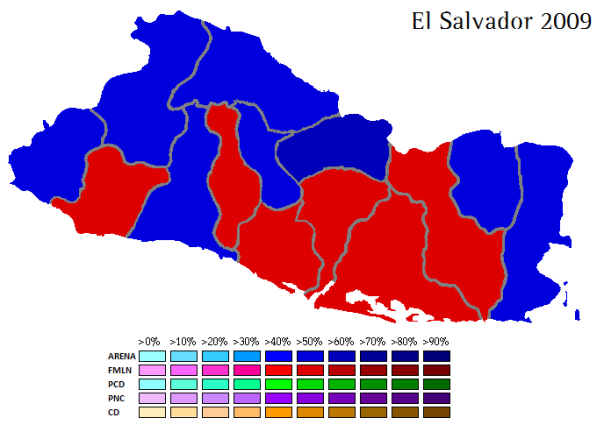
On another note, Funes has stated that he looks forward to working with President Barack Obama and the United States has stated the same thing.
El Salvador 2009
With around 90% of the votes counted in the Salvadorian presidential election, the left-wing FMLN candidate, Mauricio Funes, a 49-year old former journalist, has won the election. It is the first time that the former far-left guerilla group has won the Presidency in El Salvador. The conservative ARENA has held power since its victory in 1992 elections, and its candidate (and current President) Antonio Saca won over 57% of the votes by the first round in 2004 (the FMLN won only 35.7%). The ARENA-ally PCN and the Christian Democrats ended up not running, claiming that they had no chance.
With very high turnout (86.2%), these seem to be the result given by a lot of international sources. However, the TSE’s website is, as always, broken.
Mauricio Funes/Salvador Sánchez Cerén (FMLN) 51.1%
Rodrigo Ávila/Arturo Zablah (ARENA) 48.9%
Funes has already claimed victory, and the TSE has recognized his victory.
Hopefully more stuff later.
El Salvador 2009: Really final
Here are the full results for all 84 seats in El Salvador. Results for a few seats were withheld because a new vote had to be held in a municipality.
FMLN winning 35 seats (+1)
ARENA winning 32 seats (-2)
National Conciliation Party winning 11 seats (+1)
Christian Democratic winning 5 seats (-1)
Democratic Change winning 1 seat (-1)
El Salvador 2009: Final
I was lucky to fall across the Tribunal Supremo Electoral‘s interwebs site in my hunt for more detailed Salvadorian results. It seems that the final results are about. It seems as if the seat totals add up to only 81, and not 84, so it’s possibly the electoral system that alters seats based on votes (proportional representation by department, IIRC).
FMLN 42.83% winning 34 seats (±0)
ARENA 38.46% winning 30 seats (-4)
National Conciliation Party 8.71% winning 11 seats (+1)
Christian Democratic 6.72% winning 5 seats (-1)
Democratic Change 2.11% winning 1 seat (-1)
Under these numbers, ARENA-PCN has a majority (albeit very thin, 41 seats/81). With PDC support, it’s more comfortable. Interesting to note how inaccurate the preliminary results posted before this post were woefully inaccurate.
Below is an attempt at a map using slightly outdated numbers found a few days ago, so some of the stuff may have changed and I believe that the gray municipalities, for which they were no results, have come out. White are lakes, for lack of a better colour. Here are the results in the top 5municipalities in terms of population (2009, data from the World Gazetteer)
- San Salvador (550,828): FMLN 44.67%
- Soyapango (402,198): FMLN 55.53%
- Santa Ana (189,014): FMLN 46.39%
- San Miguel (174,467): FMLN 48.78%
- Mejicanos (165,652): FMLN 55.35%
Soyapango and Mejicanos are both suburbs of San Salvador.
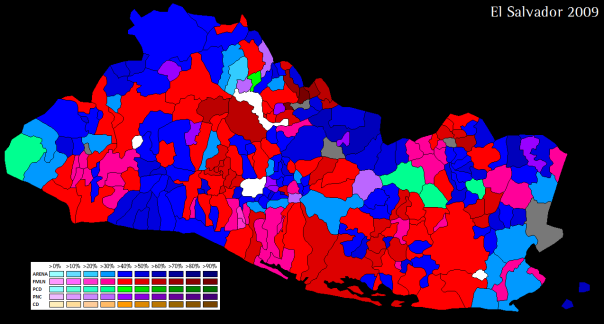
In local elections, the makeup seems to have been generally similar. However, on a positive note for ARENA, it gained the capital of San Salvador. In terms of seats, ARENA won 120, FMLN alone won 75, PCN 33, FMLN-CD 18, PDC-FMLN 2, PDC-FMLN-CD 1, FDR-CD 1, CD 1. Full results by municipality are available on the TSE website.
These results point to a close race for the presidency in March, even though the FMLN candidate is leading opinion polls.
El Salvador 2009
There are some early results in terms of seats coming from the legislative election held Sunday in El Salvador. The socialist Farabundo Martí National Liberation Front (FMLN), a former revolutionary guerilla group, seems to have defeated the ruling conservative Nationalist Republican Alliance (ARENA). No results from local elections also held on January 18.
According to Wikipedia and elsalvador.com, here are the results.
FMLN 37 (+5)
ARENA 32 (-4)
Christian Democratic 7 (+1)
National Conciliation Party 4 (-6)
Democratic Change 2 (-)
The conservative National Conciliation Party (PNC) is ARENA’s traditional allies, but ARENA + PNC gives them 36 seats. However, the Christian Democrats also side with the ARENA at times, and could provide the right-wing a majority.
However, FMLN candidate Mauricio Funes (a moderate within the FMLN, though his running-mate comes from the left of the FMLN) continues to lead the March presidential. According to a UTEC poll, he has 45.9% support against 28.6% for ARENA candidate Rodrigo Ávila. Around 21% are still undecided, according to that same poll. A candidate needs 50% +1 to win by the first round, or a runoff is held.


 World Elections